Microcement or large-format tiles: what to choose for a bathroom and living room
Large-format tiles and microcement answer the same need: fewer joints, larger planes, a calmer interior. They differ, however, in character, durability and the way they age. Instead of saying which is better, we show how each performs in specific situations.
Published · 3 min read
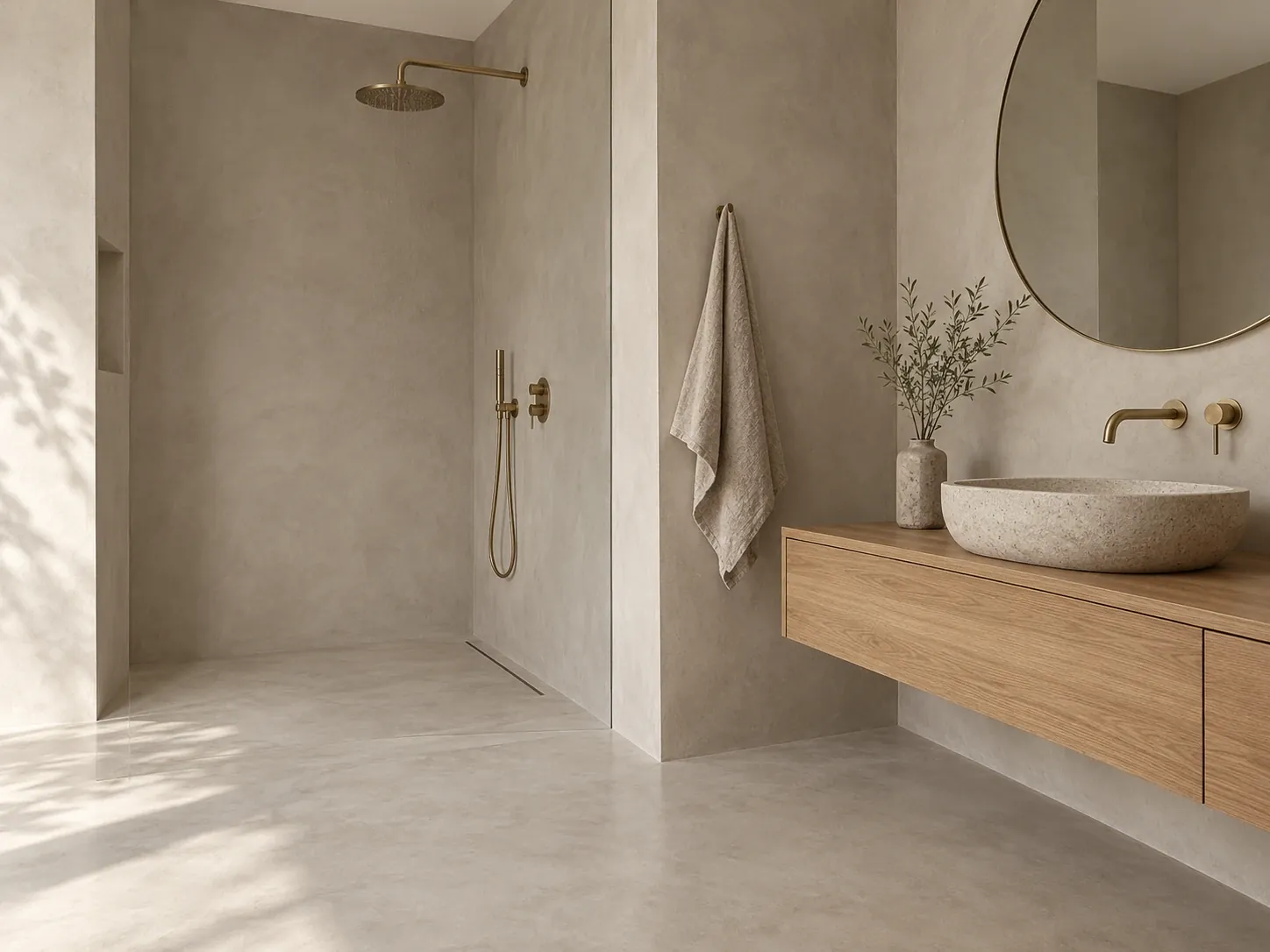
Looks: continuity versus a tile grid
Microcement forms one surface without any joints. It has a lively, hand-formed texture that changes with the light. Large-format tiles have fewer joints than traditional ones but still form a grid, and their pattern repeats. If you want a monolithic effect, microcement delivers it without compromise. If you love the drawing of stone, such as marble veining, tiles reproduce it more faithfully.
Durability and repairs
Porcelain tile is very hard and harder to scratch. When it cracks or chips, though, replacing one large-format tile is awkward and matching the batch can be impossible. Microcement is slightly more sensitive to mechanical damage, but small defects are repaired locally, and the sealer can be refreshed years later without replacing the whole surface.
Renovation time and scope
Large-format tiles need a very flat substrate and usually removal of old finishes. Laying them is quick, but preparation can be long. Microcement can often go over stable tiles without demolition, which shortens the renovation and limits dust. It does need drying breaks between layers, so the whole job also takes several days.
Everyday cleaning
Microcement has no grout lines to darken. Everyday cleaning means a damp mop with a mild cleaner. Tiles tolerate stronger chemicals, but grout, however little, eventually needs cleaning or renewing. In a bathroom with hard water both need regular limescale removal, but acidic products must not be used on microcement.
A few real-life scenarios
The choice depends on who uses the room and how.
- A family with small children and a dog: tiles in the hallway and at the garden entrance, microcement in the bathroom and on walls.
- A minimalist apartment for two: microcement on the floor, in the bathroom and on the stairs for full continuity.
- A rental apartment: tiles wherever resistance to careless tenants matters.
- Renovating without moving out: microcement over stable tiles, without weeks of demolition.
Combining both
You do not have to choose one material for the whole house. A common and very successful combination is porcelain in the most heavily used areas, such as the porch, and microcement in the living room, bathroom and on walls. Plan the junction between materials early and choose colours with samples side by side.
Underfloor heating
Both work well with underfloor heating. Microcement is thin, so it adds no significant thermal resistance and releases heat quickly. Porcelain tiles also conduct heat well, although they need a layer of adhesive. With microcement we switch the heating off during the work and bring it up gradually afterwards, as the system requires, so the coating is not exposed to sudden temperature changes.
Wet areas and waterproofing
In a bathroom both need waterproofing in the shower area. Tiles do not absorb water, but water passes through the grout, so a membrane is used under them as well. Microcement is watertight thanks to the system: waterproofing beneath and sealer on top. In both cases durability depends on careful detailing at the drain, corners and pipes.
Five questions to help you decide
Answer them honestly and the choice usually becomes obvious.
- Do I care more about a continuous, uniform surface or about the pattern and texture of stone?
- How intensively, and by whom, will the room be used?
- Can I accept removing old finishes and several weeks of noise?
- Do I accept subtle texture variations that come from handwork?
- Am I willing to use mild cleaners instead of strong chemicals?